

The Characteristics of a Curly-Coated Retriever
I have owned and trained only two curly-coated retrievers. I have never bred a litter of curlies and never actively shown, worked or competed with a curly. I have read all available books written about curly-coated retriever, heard hundreds of stories of them and met loads of them. I base the comments here (as well as everywhere else on these website) to what I have learnt when experiencing all this. I am not an expert. I only write my very own opinions and remember the dogs I have met, the stories that I was told and the experiences I have had with my two dogs.
Like all retrievers, curlies are gentle and friendly dogs. They usually like other animals and children and often get on with cats or other pets without problems. Both my curls adored children even though we never really had them visiting. Nor did we have younger children in our families, but still the dogs loved being with kids. Every time they saw a child they would go to say hello, especially when they were puppies. Curlies are patient and laid-back dogs, and usually like to lie down and keep an eye on their family. They like to be where their family is, so often they follow you around the house. When fully grown and matured, the curly-coated retriever is supposed to be less noticeable by keeping an eye on his pack from the distance.
What makes them different from labradors or golden retriever is obviously their very different looks, and also their personality. They are more likely to be protective and make great guard dogs, but curlies are never supposed to be aggressive or bite, not even if threatened. They are likely to bark and jump up if they feel they or their owner is threatened. They will also let you know if there is somebody at the door or if they hear an unusual noise. A young dog should never be encouraged to bark at people or noises unless you want him to start barking at everything, all the time!
Curly-coated retriever is not as willing to please as a labrador, and it is also more independent. Curlies tend to get bored quickly, and therefore training is sometimes considered hard work. However, in my opinion it is not difficult to train a curly-coat as such, but to keep him interested and motivated can be! He may learn things extremely quickly, but will he repeat the same command time after time after time? No, he won't! He seems to be able to judge when there is a need to obey, but if you manage to make yourself and the reward interesting enough you have better chances to get him to do what you say. It is vital to remember, that a fully grown curly can weight around 45 kg, and if not trained well enough it can be a handful! Curlies get big quickly, and boisterous dog of that size can be dangerous, even if it's not aggressive (I should know! Just have a look at the diary and other stories of this big, bouncy baby I have).
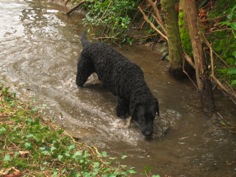
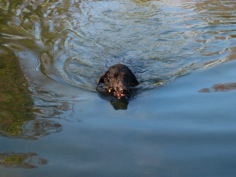
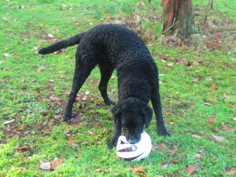
Curly-coated retriever plays and acts the same way as other retrievers. They like to chase each other when they play, roll in the ground and run after a ball (or pretty much anything). They most often love swimming too, and it can be stunning to see how strong swimmers they are, and how focused and determined they are to find the bird/ball/stick that was dropped or thrown into the water for them to find. They also have an excellent memory and scent, and that is another reason why he can be an ideal gun dog. Having said that, you can do pretty much anything with a curly-coated retriever! They may be clumsy at agility or flyball, but will sure love all kind of activity.
Curly can be happy to live in the house with it's family and go for three twenty-minute walkies per day, but he can also get destructive and frustrated if no other activity is offered. Being such an intelligent and active dog he loves getting involved in anything. They are also good at solving problems, even though they may sometimes seem a bit thick... When they are not concentrating and motivated you won't be able to train them a thing. But if they want to escape from their run, you only need to open the door once and they remember how to do that! They are good at stealing, escaping and fooling you, but again loads can be done by training and doing things together with your dog. Working as a team, whether it is to do with chasing squirrels, having a dinner or learning to sit.